
Start with a question. Build the canvas. Watch meaning emerge.
Your notes. Your thinking. Your actions.
All connected — all the way back.
See It In Action
Your canvas for deeper thinking
Connect notes to a central question. Watch relationships emerge. Let understanding unfold naturally across Question, Inquiry, Discovery, and Response.
Four Orientations
Move fluidly between Question, Inquiry, Discovery, and Response
Visual Connections
See how ideas support, contradict, or build upon each other
Association Zones
Understand relationship strength at a glance
The Problem
You capture everything.
You understand too little.
Most tools help you store what you know.
They let you capture, categorize, and retrieve — but they stop short of the harder thing: helping you make sense of it.
NotesCanvas is built for that harder thing.
It brings together questioning, inquiring, and sense-making into a single living process — where connections form across themes, domains, and disciplines, and meaning has room to emerge.
And when it does, that meaning doesn't float free. Whatever understanding arrives — whether it leads to a deeper question, a new direction, a conversation worth having, or an action worth taking — the trace of how you got there stays intact.
Because insight without its origins is just a feeling.
NotesCanvas keeps the thread.
A Method for Thought
Structure without constraint
Just as the scientific method gives researchers a reliable framework to investigate any question, NotesCanvas offers a methodology for thought — four orientations that guide your inquiry without dictating its direction.
You choose the question. The method helps you find the answer.
Four Orientations
Understanding has no fixed path
Question, Inquiry, Discovery, Response — four orientations you move between as thinking demands. The trace holds them together, so wherever you are, you can always see where understanding came from.
The thread running through all four is the epistemological trace — the visible chain that anchors action to discovery, discovery to inquiry, inquiry to the original question.
Question
Begin with a question worth exploring. Frame what puzzles you, what you want to understand, or what decision you need to make.
Inquiry
Gather notes onto a spatial canvas. Draw associations -- support, contrast, reframe. AI surfaces material you may have missed.
Discovery
Patterns surface. Record your insight, or let AI synthesize an augmented perspective from the connections you have drawn.
Response
Define what this thinking leads you to do. Your response becomes the guiding question of a new canvas -- carrying inquiry forward.
"We are drowning in information, while starving for wisdom. The world henceforth will be run by synthesizers, people able to put together the right information at the right time, think critically about it, and make important choices wisely."-- E.O. Wilson, Harvard biologist and philosopher of knowledge
From The Blog
Method to the Thinking
Exploring why methodological thinking matters in an age of information overload and AI assistance.

From Hoarding Notes to Healing Understanding
Storing notes collects the parts. Associating them around a Guiding Question helps us restore a fragmented understanding of the whole.
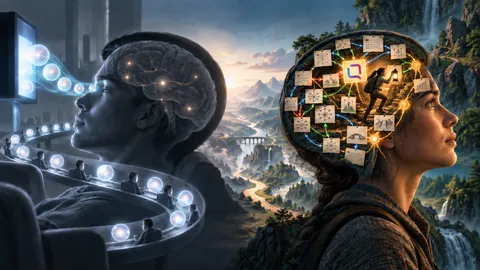
The Answer AI Gives You Is Never Truly Yours
AI can rapidly synthesize plausible answers from existing information, but those answers remain the product of the AI’s reasoning - not the user’s. This may suffice for simple questions, but complex matters require us to examine evidence, confront tensions, consider different perspectives, and recognize possibilities that no individual source already contains. NotesCanvas places the user inside this process: guided by a meaningful question, they bring their own notes and experiences into relationship, assess AI-suggested associations, and discover what emerges. Instead of outsourcing the cognitive effort through which understanding develops, the user actively trains it—and constructs an answer they genuinely understand, can defend, and call their own.
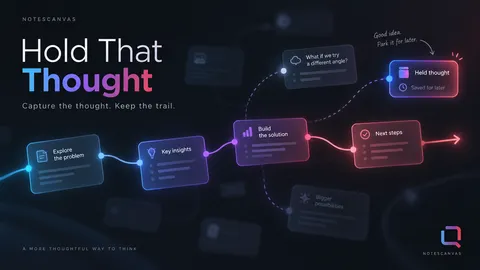
Hold That Thought: Protecting the Trail You’re Already On
You have a canvas open. Notes are appearing, moving, connecting. You are considering different perspectives, testing assumptions, following relationships, perhaps slowly beginning to see the contours of something that was not obvious when you started. And then another thought appears. Follow it, and you may discover something valuable, but you may also lose the trail you were already on. With Hold!, NotesCanvas lets you capture that emerging thought without having to follow it.
FAQ
Frequently Asked Questions
Everything you need to know about NotesCanvas.
Not in a way that bypasses your own thinking. The tool is designed to support your process—not simulate it. The goal is not to give you the feeling of thinking, but to help you actually do it.
Your mind,
made visible.
Give your ideas room to connect.
Watch the picture emerge.