The Predicament of the Talented
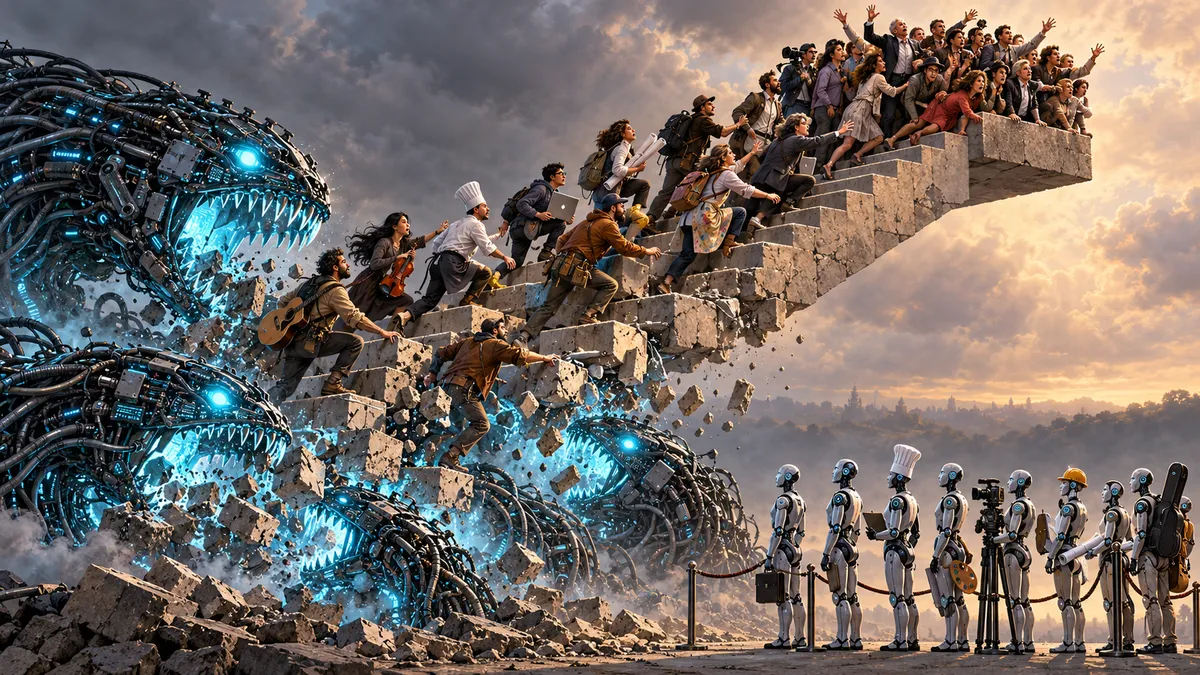
What happens when talent no longer secures your place? As AI takes on more skilled work, people climb toward orchestration, direction, and architecture—while others seek refuge in hands-on trades. But what if these are only higher steps on the same disappearing staircase? The predicament of the talented is also the predicament of those who come after them.
For much of my life, talent seemed like a reasonable place to invest your future.
Find something you are good at. Practice. Develop your abilities until you can do something others cannot, or do it better than most. Become the musician people want to hear, the programmer people trust, the designer whose work stands out.
The promise was never that success would come easily. It was that becoming exceptionally good at something would give you a place.
AI is unsettling that promise.

A guitarist may spend decades developing a distinctive sound. A programmer may spend years learning to turn complicated requirements into reliable software. Their abilities remain remarkable. But when a machine can produce output a buyer considers good enough in seconds and at a fraction of the cost, those abilities face a different economic reality.
Replacement does not require the machine to surpass everything a person can do. It requires someone to decide the machine's output is sufficient.
That is the predicament of the talented: you can become better at your craft while the market becomes less willing to pay for it.
I can see this shift in my own work.
I am architecting a software application without writing the code myself. I describe what should exist, establish relationships and boundaries, and direct agents to implement it. My attention moves toward the whole: what belongs where, how the parts should work together, and whether what emerges serves the intended purpose.
The work is demanding. The agents require direction, correction, and oversight. Yet the shift is unmistakable. I can pursue an ambition that would previously have required a much larger team to translate into code.
This seems to open a new path. If execution becomes abundant, the opportunity may shift toward those who can direct it.
The musician becomes a director. The coder becomes an architect. The specialist becomes an orchestrator.
For some, this is liberating. More of what they imagine becomes possible. But there is a troubling assumption beneath the invitation to "move up": that there will always be another level at which human contribution remains scarce.
Why should orchestration be a permanent refuge?
Architecture, coordination, and judgment also contain patterns that machines may learn to reproduce. My current role could itself become a target for automation. I cannot know how far that will go, or how quickly. But I cannot build an honest argument for the vulnerability of the coder while treating the architect as inherently protected.
We may be climbing a staircase whose lower steps keep disappearing, without knowing whether the upper ones will hold.
Against that uncertainty, the appeal of tangible work is understandable. Baking bread. Preparing meals. Repairing a home. Growing food. Work that requires a body to engage with a physical world.
There is comfort in making something you can hold. It may also offer economic relief: automating physical work requires machinery, maintenance, energy, and the ability to cope with unpredictable surroundings.
That creates friction. It does not guarantee permanence.
If robotics becomes capable and affordable enough, people who moved into physical trades may face the same question again: where do we go next?
Human-made work may retain value through relationships, trust, provenance, and the pleasure of seeing another person perform. But we should be careful not to assume those markets can support everyone displaced elsewhere.
Eventually, this becomes a question larger than career advice.
Who owns the systems doing the work? Who receives the gains? How do people obtain security, recognition, and a meaningful place in society when their abilities command less income?
Telling everyone to keep retraining leaves those questions unanswered. It places the responsibility for a structural transformation on each individual trying to survive it.
I welcome the creative possibilities these tools give me. I also recognize the contradiction: the same capabilities that expand my freedom to build may narrow someone else's opportunity to earn.
The predicament of the talented is therefore also the predicament of those who come after them.
If we succeed in making human labor less necessary, we will need to make human dignity less dependent on selling it.