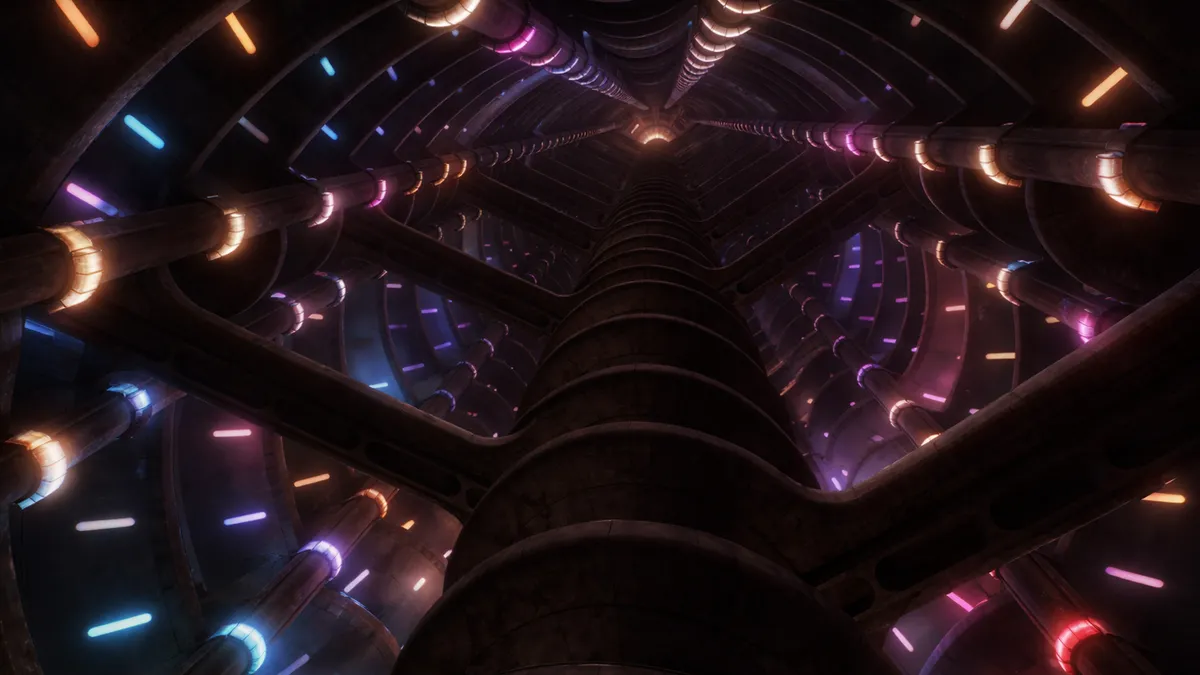
You Are Living in a Mental Silo. You Just Can’t See the Walls.
The story of Silo mirrors how people can become trapped in self-reinforcing belief systems. Organizational silos are only symptoms; the deeper issue is the mental silo, the assumptions and frames we rarely question. Modern AI often reinforces this by providing fast, fluent answers that favor intuitive thinking over deeper reasoning, creating the illusion of understanding without genuine insight. Escaping this trap requires deliberate, slow thinking and personal inquiry. Tools like NotesCanvas aim to support that process by encouraging exploration, friction, and connection, helping people think for themselves rather than outsourcing their thinking.
If you’ve watched Silo on Apple TV, you know the premise: 10,000 people living underground, bound by rules they’ve stopped questioning, looking at the outside world through a screen that tells them it’s toxic. They don’t escape — not because they can’t, but because they’ve been convinced there’s nothing worth escaping to.
Now ask yourself: how is that different from how most people use AI today?
The Silo Was Always a Mind
When Hugh Howey wrote Silo, he wasn’t writing about architecture. He was writing about belief systems that self-seal. About institutions that survive by making the outside look dangerous. About people who mistake the walls around them for the shape of reality itself.
The organizational world has its own version of this. We’ve called them silos for decades — departments that don’t talk, strategies that don’t connect, leaders who optimize their corner while the whole system slowly fails. RoundMap was built as a direct response to that: a regenerative framework designed to reconnect what fragmentation had severed.
But here’s what we underestimated. The organizational silo was never the root problem.
The root problem is the mental silo.
The silo in the org chart is just a symptom. The deeper structure — the one that’s harder to see and far more dangerous — is the one inside the heads of the people who drew that chart. Fixed assumptions. Invisible frames. The unquestioned premise that shapes every question you’re willing to ask.
You can flatten a hierarchy. You can redesign a workflow. You cannot reorganize your way out of a worldview you don’t know you’re inside.
AI Is Making the Walls Comfortable
Here is the confronting truth about the AI revolution nobody wants to say plainly: AI, in its dominant form, is not a thinking tool. It is a thinking replacement.
And the replacement is seductive precisely because it’s frictionless. You don’t struggle. You don’t sit with uncertainty. You don’t follow a thread into uncomfortable territory and discover something that unsettles your assumptions. You ask, and you receive. Instantly. Fluently. Confidently.
Kahneman spent a career showing us that the mind has two operating modes: the fast, associative, effort-avoiding System 1, and the slow, deliberate, friction-seeking System 2. System 2 is where genuine understanding lives — where you build mental models, make unexpected connections, and arrive at thoughts that are actually yours.
AI optimizes for System 1. It quietly drains System 2.
The result is not stupidity. It’s something more insidious: the sensation of thinking without the substance of it. People who can fluently discuss ideas they’ve never actually wrestled with. Conclusions without the scar tissue of the reasoning that should have produced them.
This is the mental silo in its most advanced form. Not ignorance — but the comfortable illusion of knowledge. Not walls you can see — but walls that feel like windows.
The screen in the Silo doesn’t show nothing. It shows a world that looks explored, understood, safely interpreted. That’s what makes it a prison.
A Small Act of Defiant Thought
In the series, the rebellion doesn’t start with a revolution. It starts with a single person who decides to look more carefully at what they’re actually seeing.
That is the only way out of a mental silo, too.
Not more information. Not faster answers. Not a better AI. The way out is the disciplined practice of thinking for yourself. Following your own inquiry, building your own connections, sitting long enough with a question that something genuinely new emerges.
Brian Solis, the only figure from the broader business world who endorsed RoundMap with his signature, carries this tension in his own name. Rearrange it: Brain Silos. It sounded like a coincidence until we realized it describes exactly what we’ve been fighting all along.
The Instrument That Determines What You Can See
We built NotesCanvas because the problem needed a response that operated at the right level: not organizational, but cognitive.
NotesCanvas is a slow-thinking canvas. It does not retrieve answers. It does not summarize. It does not complete your thoughts for you (although it can offer some help). It creates the conditions in which you build the instrument, your mind, that determines what you’ll be able to see next.
Where AI closes loops, NotesCanvas opens them. Where AI reduces friction, NotesCanvas uses friction deliberately because friction is how thought deepens, how connections form, how understanding becomes genuinely yours.
The tagline is simple: Where connected thoughts reveal deeper truths.
But the proposition behind it is a challenge: are you willing to think, or have you already outsourced that too?
The walls of a mental silo are invisible by design. The most confined minds are the ones most certain they’re free.
The question isn’t whether you’re in a silo.
The question is whether you want out.