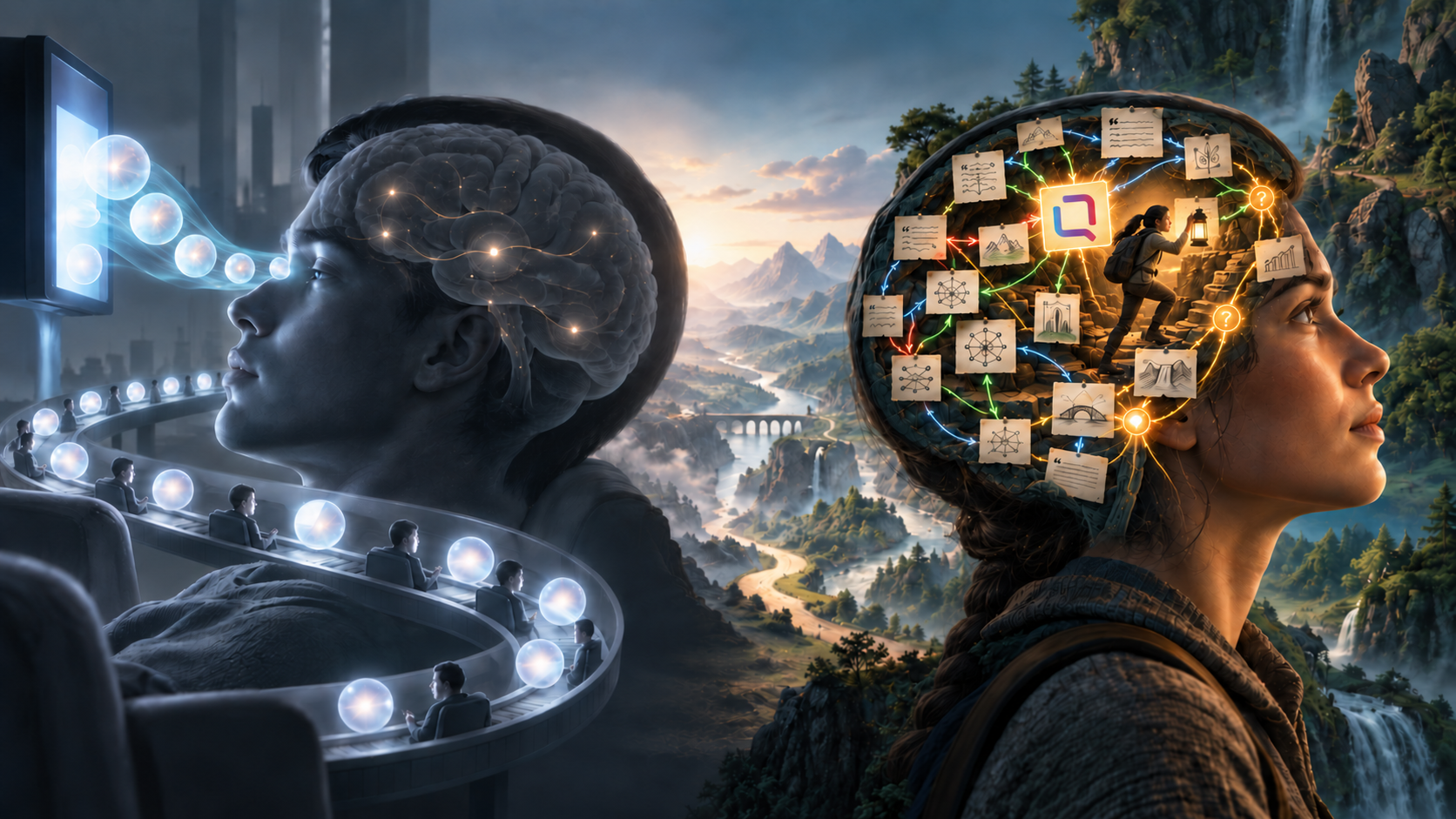
The Answer AI Gives You Is Never Truly Yours
AI can rapidly synthesize plausible answers from existing information, but those answers remain the product of the AI’s reasoning - not the user’s. This may suffice for simple questions, but complex matters require us to examine evidence, confront tensions, consider different perspectives, and recognize possibilities that no individual source already contains. NotesCanvas places the user inside this process: guided by a meaningful question, they bring their own notes and experiences into relationship, assess AI-suggested associations, and discover what emerges. Instead of outsourcing the cognitive effort through which understanding develops, the user actively trains it—and constructs an answer they genuinely understand, can defend, and call their own.
NotesCanvas helps you construct one that is.
When you ask a general-purpose AI a question, it usually tries to produce an answer immediately. Sometimes it draws on patterns learned during training; when browsing is available, it may also search the internet for relevant information. It compares what it can retrieve, looks for agreement and disagreement, and synthesizes what appears to be the most plausible response.
When the available sources broadly agree, the answer may be presented with considerable confidence. When they conflict, the AI may search further, qualify its conclusion, or attempt to reconcile the different accounts.
This can be remarkably useful but it has limits.
The sources available to an AI are not a neutral or complete representation of everything that is known. Retrieval tends to favour information that is accessible, well indexed, widely referenced, published by prominent domains, or optimized for search and AI discovery. The resulting answer may rest on only a handful of sources, while less visible knowledge, minority perspectives, lived experience, internal documents, and important contextual evidence remain outside its field of view.
For relatively straightforward questions, this is often adequate. Complex matters, however, rarely depend on information alone. They involve competing interpretations, hidden assumptions, contextual differences, tensions between perspectives, and consequences that change depending on whose position we consider.
An AI may therefore produce an answer that sounds coherent and is reasonably supported, yet still frames the matter incorrectly or points you in the wrong direction.
There is also a temporal limitation. AI can extrapolate, recombine ideas, and propose possible futures, but it must do so from information and patterns that already exist. To some extent, it can look beyond the rear-view mirror by identifying trends, weak signals, and plausible discontinuities. But it cannot retrieve evidence about a future that has not yet occurred.
More importantly, the reasoning through which it reaches these possibilities is not the user’s reasoning.
The AI performs the synthesis and presents its conclusion. The user can question, inspect, or reject that conclusion, but unless they actively reconstruct the relationships behind it, they are still receiving an answer rather than developing their own understanding.
That distinction matters when dealing with complex questions. The purpose is not merely to obtain a plausible conclusion. It is to understand why certain information matters, how different perspectives relate, where assumptions conflict, what remains uncertain, and which emerging possibilities deserve attention.
That kind of understanding cannot simply be transferred as a finished answer. It must be constructed by the person who will ultimately rely on it.
This is where #NotesCanvas takes a fundamentally different approach.
NotesCanvas does not begin by trying to close the question. It creates the conditions in which the user can investigate it.
Within NotesCanvas, deliberate — or what Kahneman called System 2—thinking can be oriented around a Guiding Question. When you open a new thinking canvas, you are invited to formulate such a question. Providing one is not mandatory, but it gives the inquiry a clear point of orientation.
The Guiding Question also enables the system to suggest notes from your Notes Library that may bear on the matter in some meaningful way. These notes may contain knowledge gathered previously, fragments of lived experience, observations, quotations, unresolved questions, emerging ideas, or perspectives that have not yet been brought together.
They are not treated as ready-made answers.
One note might provide supporting evidence. Another may expose an assumption, introduce missing context, challenge an emerging conclusion, or suggest a connection that had not previously been considered.
But how are these different contributions weighed?
NotesCanvas distinguishes between ten types of association, organized into four families: Tensions, Context, Supports, and Emerges. When you add a note to a spatial thinking canvas, the system can suggest an association and explain why that relationship may be relevant.
The user remains responsible for judging whether the proposed relationship is meaningful.
This places the user inside the reasoning process. AI may surface relevant notes, propose associations, and explain possible connections, but the user determines what belongs, which tensions matter, what should be challenged, and what the combined material reveals.
AI supports the inquiry without taking ownership of it.
This also changes the role of the notes themselves. They are no longer merely stored pieces of information. They become perspectives within an evolving field of inquiry. Their meaning is not limited to what they say individually; it also arises from how they support, contextualize, contradict, or transform one another.
The association family Emerges is especially significant. It directs attention beyond what the individual notes already contain. By bringing different observations, experiences, tensions, and possibilities into relationship, the user may recognize something that no source states explicitly: a new interpretation, an approaching change, an adjacent possibility, or a question that could not have been formulated beforehand.
This is how NotesCanvas can help users look forward without pretending that the future can simply be retrieved.
A conventional AI interaction asks:
What answer can the AI construct for me from the information available?
NotesCanvas asks:
What understanding can I construct by bringing relevant knowledge, experience, tensions, and perspectives into relationship around the question that matters to me?
The first gives you access to the AI’s synthesis.
The second uses AI to strengthen your own capacity to reason, integrate, anticipate, and construct an answer you genuinely understand — and can call your own!