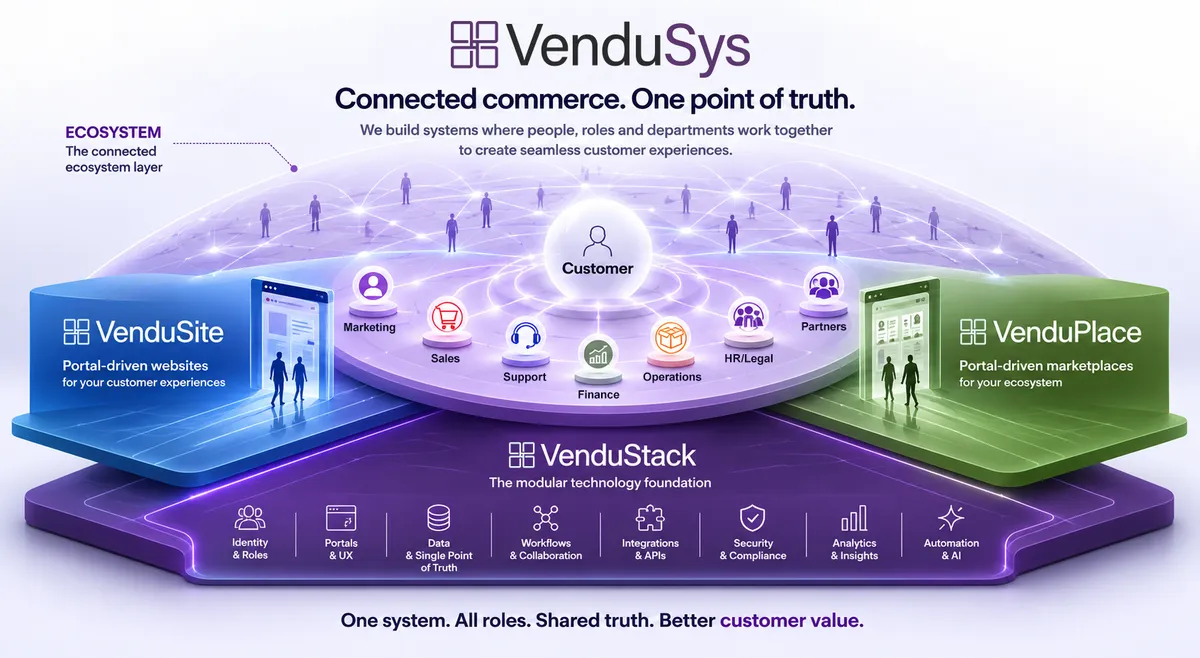
How Thinking Slow Led to Building a Value Orchestration Infrastructure
For years, I was trying to understand why so many organizations, despite their best intentions, struggle to create lasting value. That journey led me to question some of the most fundamental assumptions in business: that commerce is primarily about transactions rather than relationships, that organizational silos improve performance, that financial success is the ultimate measure of value, and that technology should optimize existing processes instead of transforming them. This article tells the story of how that slow process of inquiry gave rise to RoundMap®, and ultimately to VenduSys: a Value Orchestration Infrastructure designed to help businesses regenerate the ecosystems they depend on by making relationships, learning, and collective value creation central to how they operate.
For years, I was trying to answer a question.
Why do so many organizations, despite employing talented people and investing heavily in technology, gradually lose touch with the very people and ecosystems they depend on?
The answer didn't emerge overnight. It took years of observing organizations, questioning accepted management practices, and resisting the temptation to settle for easy explanations. It was a process of thinking slowly—looking beneath symptoms to understand the systems that produced them.
That journey eventually became RoundMap®.
But it didn't end there.
It led to something I hadn't anticipated: the realization that if we truly want business to serve society while remaining economically healthy, we need more than new ideas. We need a different kind of infrastructure.
When Customers Became Transactions
Modern commerce has become remarkably efficient at managing transactions.
Marketing generates leads.
Sales closes deals.
Operations fulfils orders.
Finance records revenue.
Customer Service resolves incidents.
Each function performs its task, often exceptionally well. Yet somewhere between these specialized activities, something essential disappears.
The relationship.
The customer gradually becomes fragmented into records, tickets, invoices, campaigns, forecasts, and KPIs. Every department sees only a slice of reality. The organization itself becomes a collection of perspectives rather than a coherent whole.
This fragmentation doesn't happen because people don't care.
It happens because the systems they're given encourage them to optimize parts instead of nurturing relationships.
Ironically, we continue to call this customer-centric.
The Missing Feedback Loop
One of the insights that shaped RoundMap was that Customer Success isn't merely another department.
It is the regenerative feedback loop through which organizations learn.
Every interaction with a customer contains knowledge.
Every implementation reveals assumptions.
Every complaint exposes friction.
Every success story uncovers value that can be amplified.
Without a continuous feedback loop, organizations stop learning. They continue selling yesterday's assumptions while the world quietly changes around them.
Customer Success, therefore, isn't simply about reducing churn.
It is about continuously regenerating organizational intelligence.
The Cost of Organizational Silos
The same fragmentation exists far beyond customer relationships.
As organizations specialized, expertise increased—but coherence declined.
Departments became functions.
Functions became objectives.
Objectives became metrics.
Metrics became incentives.
Eventually, people stopped asking whether the organization was becoming healthier and focused instead on whether their own department was performing.
This dissociation isn't merely an organizational problem.
It changes how decisions are made.
The more fragmented our view becomes, the easier it becomes to externalize costs onto others.
- Suppliers absorb pressure.
- Employees absorb stress.
- Communities absorb pollution.
- Governments absorb risk.
- Nature absorbs depletion.
From within each silo, these decisions often appear rational.
From the perspective of the whole system, they steadily weaken the commons upon which everyone depends.
Financialization Changed the Purpose of Business
Over the past decades, another shift quietly reshaped the economy.
Business increasingly became subordinate to finance.
Growth became an expectation rather than an outcome.
Debt financed expansion.
Shareholder returns became the dominant measure of success.
Efficiency often meant extracting more while investing less in the long-term health of relationships.
Growth itself isn't the problem.
Healthy systems grow.
But in nature, growth is always balanced by regeneration.
When extraction consistently exceeds regenerative capacity, decline becomes inevitable—even if financial statements temporarily suggest otherwise.
The same principle applies to businesses, communities, and ecosystems.
Returning Business to Its Natural Role
If business exists to create value, then value cannot be measured solely by what shareholders receive.
Value also resides in:
- healthier customers,
- more capable employees,
- stronger suppliers,
- resilient communities,
- thriving ecosystems,
- trust,
- knowledge,
- relationships.
These forms of value are not externalities.
They are the very conditions that make long-term economic success possible.
This requires moving beyond viewing stakeholders as parties to be managed.
Instead, they become participants in a living system that continuously co-creates value.
From Commerce to Value Orchestration
Commerce has traditionally been understood as facilitating exchange.
Its natural unit is the transaction.
But the economy emerging around us is increasingly driven by relationships rather than isolated exchanges.
Knowledge compounds.
Trust compounds.
Communities compound.
Learning compounds.
Networks compound.
The fundamental question therefore changes.
Instead of asking:
How do we optimize transactions?
We begin asking:
How do we continuously orchestrate value across an interconnected ecosystem?
That shift—from transactions to relationships—changes everything.
The objective is no longer maximizing extraction.
It becomes enabling every stakeholder to contribute, learn, benefit, regenerate, and strengthen the system as a whole.
That is what I mean by Value Orchestration.
Why Ideas Alone Are Not Enough
RoundMap provided the intellectual framework.
It helped explain why organizations drift apart, why ecosystems weaken, and how businesses might become regenerative rather than extractive.
But frameworks don't change organizations by themselves.
People do.
And people need systems that reinforce the behaviours they aspire to.
If software continues to separate Sales from Service, Finance from Operations, Customers from Suppliers, and Organizations from their ecosystems, then even the best leadership intentions will eventually erode under operational reality.
Ideas require infrastructure.
Building a Value Orchestration Infrastructure
That realization ultimately led me somewhere I never expected.
I didn't set out to build another business application.
I set out to build an infrastructure capable of supporting the continuous flow of value, knowledge, and relationships across entire ecosystems.
An infrastructure that connects rather than fragments.
One that enables organizations not merely to record transactions, but to learn collectively.
One that transforms customer interactions into organizational intelligence.
One that helps businesses understand not only the value they capture, but the value they create, distribute, regenerate, and sometimes unintentionally destroy.
One that makes measuring ecosystem impact as important as measuring financial performance.
That infrastructure became VenduSys.
If RoundMap® asks us to see organizations as living systems, then VenduSys exists to help them operate as living systems.
Together, they represent two halves of the same journey.
One provides the philosophy.
The other provides the means.
Because meaningful change rarely begins with technology.
It begins with thinking slowly enough to question the assumptions everyone else has stopped noticing.
"Shared Value Networks don't emerge from goodwill alone. They depend on an infrastructure capable of orchestrating relationships, knowledge, decisions, transactions, and feedback across an ecosystem. That infrastructure is what I call a Value Orchestration Infrastructure."