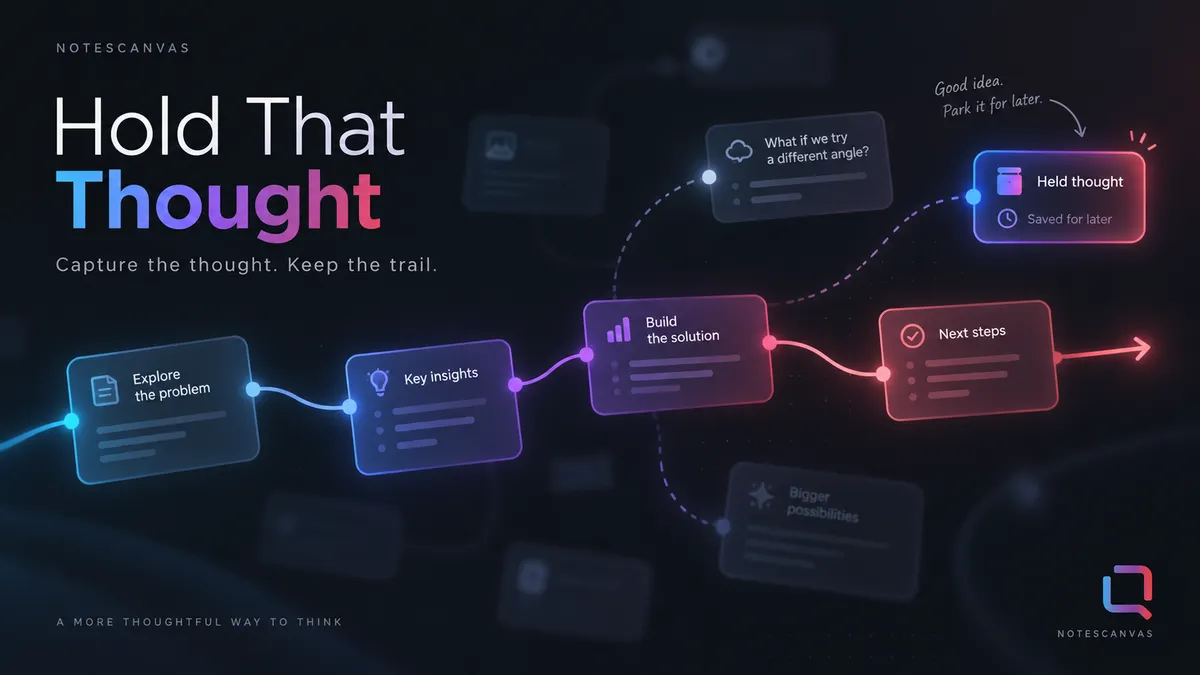
Hold That Thought: Protecting the Trail You’re Already On
You have a canvas open. Notes are appearing, moving, connecting. You are considering different perspectives, testing assumptions, following relationships, perhaps slowly beginning to see the contours of something that was not obvious when you started. And then another thought appears. Follow it, and you may discover something valuable, but you may also lose the trail you were already on. With Hold!, NotesCanvas lets you capture that emerging thought without having to follow it.
There is a particular moment that happens when you are deeply engaged in thinking.
You have a canvas open. Notes are appearing, moving, connecting. You are considering different perspectives, testing assumptions, following relationships, perhaps slowly beginning to see the contours of something that was not obvious when you started.
And then another thought appears.
I should look deeper into this.
Or:
There must be evidence that supports—or challenges—this.
Or perhaps:
What would happen if we took this idea in an entirely different direction?
It may be a good thought. It may even turn out to be an important one.
But it is not the line of thought you are pursuing right now.
That creates a small dilemma.
Follow it, and you may discover something valuable—but you may also lose the trail you were already on. Ignore it, and you risk forgetting something that felt significant enough to interrupt you in the first place.
Neither option is particularly satisfying.
So we added a third.
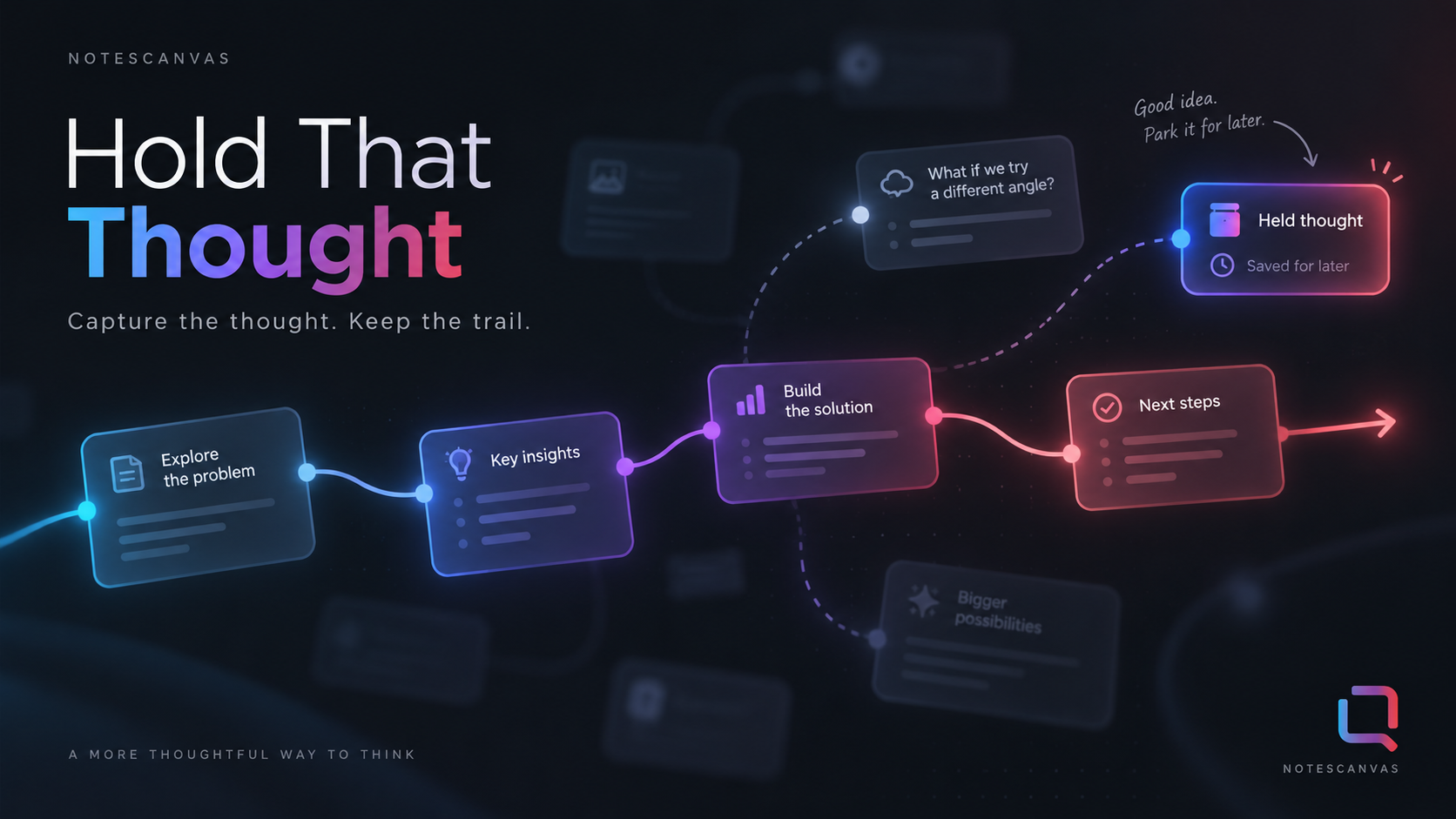
Hold that thought
With Hold!, NotesCanvas lets you capture that emerging thought without having to follow it.
You simply put it somewhere safe.
Write down what occurred to you. Add, if useful, why you thought it might matter. Preserve the notes and context that gave rise to it. Then return to what you were doing.
No detour required.
The thought remains there, waiting for whenever you decide the time is right to pick it back up.
That may be later that afternoon. Next week. Three months from now. Or perhaps never.
That is entirely up to you.
Because Hold! is not a task manager.
It does not turn every thought into an obligation.
There is no due date. No priority. No overdue warning. No status telling you that something remains unfinished.
A Held Thought merely says:
Something occurred to me here that seemed worth exploring—but not now.
That distinction matters.
From Aha! to Hold!
NotesCanvas already supports another kind of meaningful moment: the Aha! Moment.
An Aha! happens when something becomes clear.
Perhaps two notes suddenly connect. An assumption falls away. A pattern emerges. Something you have been looking at for some time is suddenly seen differently.
That moment is worth capturing because insights can be surprisingly fragile. A few hours later, you may remember the conclusion but no longer remember what caused you to see it.
So an Aha! Moment preserves more than the insight itself. It can preserve the context in which the insight emerged—the notes, relationships, and line of inquiry that illuminated it.
Hold! comes from the same philosophy, but serves a different moment.
An Aha! says:
Something just became clear. Capture it.
Hold! says:
Something just occurred to me. Preserve it, but don’t follow it yet.
One captures a realization.
The other protects your attention.
Because good thinking creates side trails
Deep inquiry rarely follows a perfectly straight path.
The more carefully we examine something, the more possibilities we begin to notice. One question exposes another. One connection suggests three more. An unexpected note may open an entirely different avenue of inquiry.
That is part of what makes slow thinking valuable.
But it also creates a danger: every interesting possibility can become an invitation to abandon the inquiry that produced it.
Before long, we are no longer investigating the original question. We are five branches away, researching something fascinating but entirely different.
Hold! gives those branches somewhere to go without requiring you to travel down them immediately.
It is a way of saying:
Yes, this matters. And no, I don’t need to deal with it right now.
There is something liberating about that.
Once the thought has been captured, you no longer have to keep rehearsing it mentally so that you do not forget it. You can let it go and return your attention to the trail you chose to follow.
Pick up the trail when you are ready
Held Thoughts remain available alongside your canvas.
When one catches your attention again, you can Revisit it.
Not because NotesCanvas has decided it is overdue.
Not because a productivity system has moved it into today's queue.
Simply because you are ready to go back in.
And when you do, the original context is still there.
You can remember where the thought came from, why it seemed significant, and which notes were involved when it occurred. From there, you are free to follow the trail.
You may deepen it.
Challenge it.
Look for evidence.
Connect it to another canvas.
Discover that it leads somewhere entirely unexpected.
Or decide that what once looked promising no longer matters.
All of those are legitimate outcomes.
Because the purpose of Hold! is not to ensure that every captured thought gets completed.
It is to make sure that a worthwhile thought does not have to compete for your attention the moment it appears.
Staying with the question
Much of modern productivity software is designed around deciding what to do next.
NotesCanvas is interested in something slightly different:
How do we stay with a question long enough to see what we might otherwise miss?
Sometimes that means capturing the breakthrough:
Aha!
And sometimes it means resisting the breakthrough's tempting cousin - the interesting diversion:
Hold!
One helps us preserve what has emerged.
The other helps us preserve what might emerge later.
Together, they allow something deceptively simple:
Follow the thought that matters now, without losing the thoughts that may matter next.